
About Ragas
Samay Chakra: The Time Cycle of Raags in Hindustani Classical Music
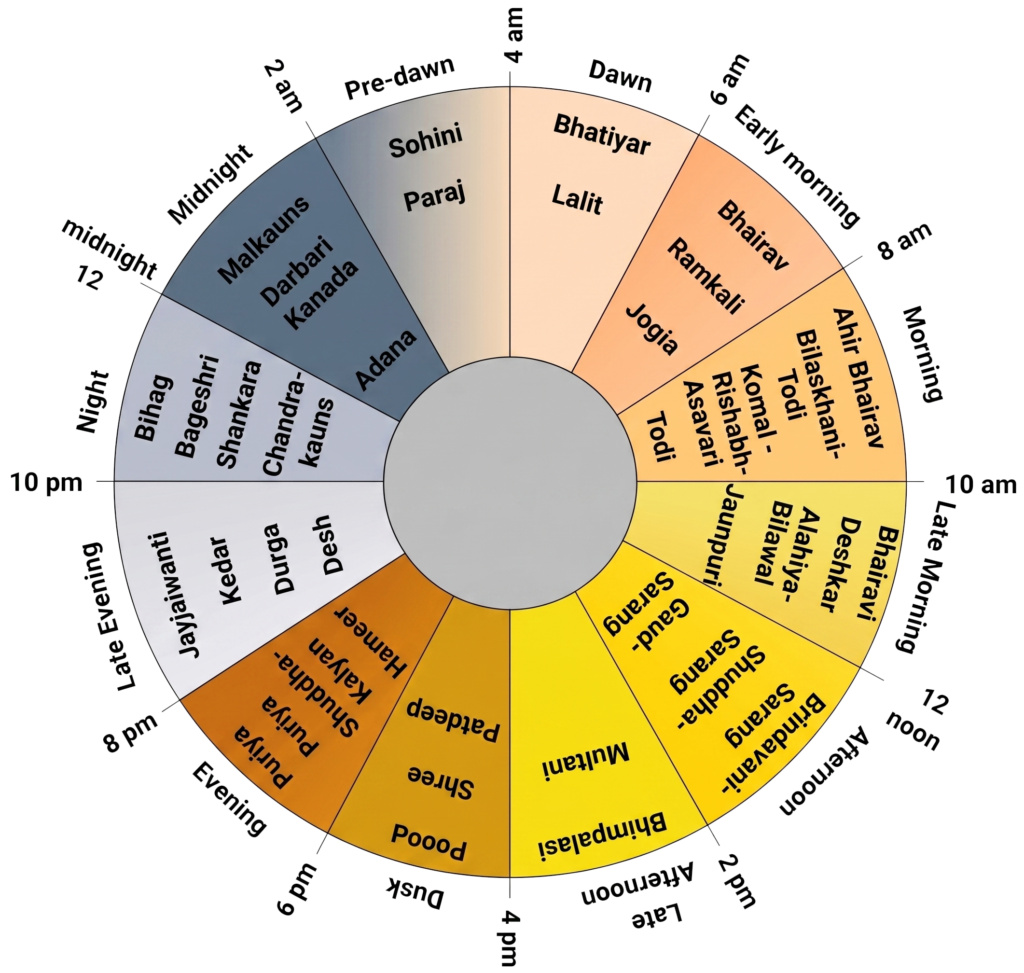
Hindustani classical music gives every raag its own time of day. That time is linked to the raag’s vaadi swar (its most important note) and samvadi swar (its second most important note). Sung at its proper hour, a raag is believed to bring out its ras, or mood, most fully, and evoking that mood is the performer’s central task.
Some raags are tied to a season rather than an hour. Raags of the Malhar family, for instance, may be sung at any time during the monsoon. Tradition also pairs certain raags with certain seasons: Megh with the monsoon, Bhairav with autumn, Malkauns with winter and Hindol with spring.
The Two Halves of the Day
1. Poorva Bhaag
Midnight to noon is the Poorva Bhaag, the first half of the day. Raags performed in this half are known as Poorva Raags.
2. Uttar Bhaag
Noon to midnight is the Uttar Bhaag, the second half of the day. Raags performed in this half are known as Uttar Raags.
The saptak (octave) is divided in the same way. Its lower half, Sa Re Ga Ma, is called the Poorvang; its upper half, Pa Dha Ni and the upper Sa, is called the Uttarang.
• Poorvang Vaadi Raag •
When a raag’s vaadi swar falls in the lower half of the octave, it is a poorvang vaadi raag and belongs to the first half of the day, from midnight to noon.
• Uttarang Vaadi Raag •
When a raag’s vaadi swar falls in the upper half of the octave, it is an uttarang vaadi raag and belongs to the second half of the day, from noon to midnight.
Knowing a raag’s vaadi swar,
we can tell roughly when in the day it is meant to be sung.
Hindustani and Carnatic Traditions
India has two classical raag traditions: Hindustani in the north and Carnatic in the south. The Hindustani tradition links raags to particular times of day and seasons, reflecting the belief that our mood and state of mind move with the daily and seasonal rhythms of nature. The Carnatic tradition stays closer to the text and places much less weight on time or season.
Key Aspects of Ragas
Emotion
Every raag is meant to evoke a particular feeling, such as love, peace or courage.
Time and Season
Many raags belong to a time of day or a season. Morning raags tend to be gentle, evening raags more expressive, and some are tied to seasons such as the monsoon or spring.
Classification
Hindustani music groups its raags under 10 parent scales called thaats, while Carnatic music uses 72 parent scales called melakartas.
Performance
A raag is a framework for improvisation rather than a fixed tune, so a single performance can last anywhere from a few minutes to more than an hour.
Types of Ragas
There are over 83 different types of raags in Hindustani classical music. Here are some of the principal ones.
Raag Asavari
The parent raag of Asavari thaat, traditionally sung in the late morning. It combines shuddha (natural) Re with komal (flat) Ga, Dha and Ni, which give it a devotional, slightly melancholic mood. A well-known bandish (composition) in this raag is the chhota khayal “Are man samajh samajh pag dhariye” in Teentaal.
Raag Bhairav
A steady, evenly paced raag for the early morning. Traditionally it is the first raag a student practises at the start of the day.
Raag Bilawal
The parent raag of Bilawal thaat. It uses all seven notes in their shuddha (natural) form, so its scale matches the Western major scale. It is traditionally sung in the morning.
Raag Kafi
The Hindustani counterpart of the Carnatic raag Kharaharapriya. Its evenly balanced phrases make it a foundation on which many lighter raags are built.
Raag Kalyan
Heard widely in devotional and spiritual music, Kalyan takes its name from a word meaning blessing or good fortune. It is one of the most frequently performed raags and is usually sung in the evening.
Raag Khamaj
A lighter, graceful raag and one of the most popular in Indian classical music. It is usually performed late at night.
Raag Marwa
Often called the sunset raag, as it is sung in the evening. It leaves out Pa, the fifth note of the scale.
Example Songs
Raag Khamaj
Hindi
Bengali
- Ami Chini Go Chini Tomare (Charulata)
- Bhalobasi Bhalobasi (Shwet Pathorer Thala)
Raag Hameer
Hindi
- Madhuban Mein Radhika Nache Re (Kohinoor)
Bengali
- Amar E Poth Tomar Pather Theke (Rabindra Sangeet)